Water Quality and Supply Issues Monthly Update - June 2026
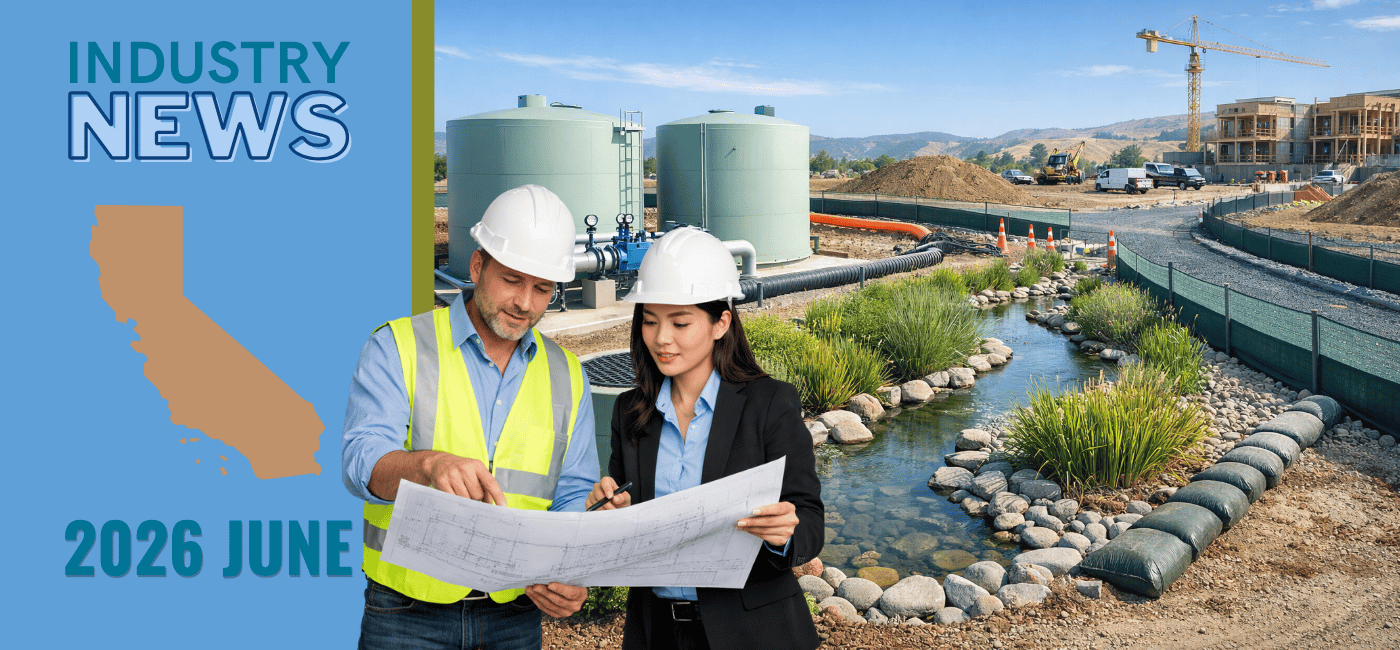
Summer has officially arrived in California, and with it comes new opportunities and new challenges for the construction industry. Longer days and warmer weather often mean increased project activity, but they also serve as an important reminder to prioritize job site safety and stormwater compliance. Even a brief summer thunderstorm can create significant runoff issues if proper erosion and sediment controls are not in place.
Here’s what you need to know in June:
💧 Southern California MS4 Permit Update
The Santa Ana Regional Water Quality Control Board has released its final Tentative Order for a Regional MS4 Permit, introducing important changes that will affect future development and redevelopment projects across the region.
🏗️ High Rate Biofilters Receive Important Recognition
Los Angeles County Public Works has confirmed that High Rate Biofiltration devices may be used to satisfy key Regional MS4 Permit requirements, providing additional flexibility and compliance options for development projects.
🌊 State Water Allocation Finalized at 45%
The California Department of Water Resources has announced a final 45% allocation for State Water Contractors, reflecting current hydrologic conditions and ongoing statewide water supply considerations.
👇 At CICWQ, we remain committed to providing timely information, practical insights, and strong advocacy on the water quality policies that impact California’s construction industry. We encourage you to explore each update below to better understand the regulatory developments, opportunities, and challenges shaping our industry today.
JUNE NEWSWORTHY ITEMS
1️⃣ Final Tentative Order for a Regional Municipal Separate Storm Sewer System (MS4) Permit Released by the Santa Ana Regional Water Quality Control Board
The Santa Ana Regional Water Quality Control Board released the Tentative Order for the Santa Ana Watershed Regional MS4 Permit, covering portions of Orange, Riverside, and San Bernardino counties. Following stakeholder requests for additional review time, the Regional Board has extended the public comment period to July 20, 2026. In addition, a public workshop is now scheduled for July 24, 2026, in the City of Orange, with a potential permit adoption hearing scheduled for August 21, 2026.
The Regional MS4 permit is the first of its kind for the Santa Ana River Watershed, consolidating three separate permits that were first issued for individual counties in the 1990s and renewed separately thereafter until now. CICWQ, and especially its Building Industry Association members representing housing, have been involved every step of the way in permit development, as the compliance requirements of the proposed Regional MS4 permit affect nearly every housing project to be built in the 3-County area.
The CICWQ permit language review focused on many areas, with several critical areas standing out: (1) definition of key terms, (2) time allowance before new permit requirements go into effect, and (3) recognition by the Regional Board concerning existing hardened channel exemptions, also known as Hydromodification Control.
Most importantly, CICWQ and many other supportive stakeholders secured an essential change in the definition of “Impervious Surface” through the elimination of the word “gravel”, which was originally included by the Regional Board. The inclusion of any gravel surface would have been a high added cost to a housing project, as gravel and rock products are used extensively in modern, water-saving, and fire-resistant landscapes, paths, and roads. Also, on the positive side, the period for which projects may be approved under the currently effective MS4 permits is now two (2) years from the final date of permit adoption.
Most concerning to CICWQ, however, is the potential loss of hard channel Hydromodification Control exemptions already granted by the Santa Ana Regional Board. Especially in Riverside and San Bernardino Counties, there are existing flood-control channels and what were once “streams” or “drainage ways” that have been significantly hardened to protect against erosion and damage. Because of new language in the Tentative Order, the Counties are concerned that existing “exemptions” that have been granted by the Regional Board may go away, and new, time-consuming and expensive engineering studies and mapping must be done to prove an existing “exemption”.
This is concerning for housing, as it could result in additional fees and costs should existing studies be tossed out. Also, if an exemption is dropped and a flood channel or waterway is deemed “susceptible”, it could force home builders to install very large and expensive on-site/parcel-level water capture controls, which take up valuable development space.
2️⃣ Los Angeles County Public Works Issues Clarification Letter to CICWQ, Confirming Allowance of High Rate Biofiltration Systems to Meet Los Angeles Regional MS4 Permit Requirements
Earlier this year, in March, CICWQ submitted a request letter to Los Angeles County Public Works for clarification on the implementation of high-rate biofiltration (HRBF) systems as biofiltration BMPs under the Los Angeles County LID Manual and the Los Angeles Regional MS4 Permit (Order R4-2021-0105).
Simply put, HRBF systems are an essential stormwater treatment option for MS4 permit compliance, especially in dense urban areas where total or even partial infiltration of what is known as the “Design Storm” is limited by technical feasibility constraints, such as poor soils or insufficient space. Based on that letter, Los Angeles County Public Works issued a letter to CICWQ in late May, affirming that, under clear engineering feasibility analysis conditions, project proponents may use HRBF systems as appropriate and in accordance with the terms and conditions clearly defined in the Los Angeles Regional MS4 permit.
CICWQ has, for many years, fostered a collaborative partnership with Los Angeles County Public Works to advance stormwater management and water quality improvement and create more housing development opportunities wherever possible. The HRBF Clarification Letter is a step forward in our partnership with the County, and we are truly grateful for their support!
3️⃣ California Department of Water Resources Updates State Water Contractors Final Allocation for 2026 – 45% of Requested Supplies
The Department of Water Resources (DWR) announced an increase to the State Water Project (SWP) allocation for 2026. The allocation is now 45 percent of requested supplies, up from the previous allocation of 30 percent announced on January 29. According to an announcement by DWR, while California saw record heat in March and early snowmelt, consistent rainstorms in April provided critical runoff across the system, allowing DWR to capture more water and meet environmental regulations without using stored water. Currently, the SWP’s largest reservoir, Lake Oroville, is at 99 percent of capacity. Statewide, reservoirs are 117 percent of average for this time of year.