The dog days of summer have arrived across California, bringing persistent heat and a renewed focus on the water resources, infrastructure, and environmental conditions affecting our communities and the construction industry.
While many Californians look for ways to cool down, CICWQ continues to monitor the policy, permitting, and water quality developments that could shape project planning and compliance in the months ahead.
Here’s what you need to know in August:
🌧️ Could Fall and Winter 2026–27 Bring Historic Rainfall to California?
Forecasters report a strengthening El Niño pattern that could bring above-average rainfall, erosion risks, and coastal and marine-resource impacts to parts of California, though local outcomes are never guaranteed.
🎙️ August 25 Webinar: Navigating California’s New MS4 Permits
Join CICWQ Principal Technical Director Dr. Mark Grey and a panel of public works and land development experts for an important discussion of the proposed regional permit, its new Uniform Technical Guidance requirements, and potential compliance costs that may exceed $11 billion.
👇 Read on for the latest context, key considerations, and opportunities to stay informed and engaged on both of these important issues.
AUGUST NEWSWORTHY ITEMS
1️⃣ Fall and Winter 2026-27 Could Be Historic for Rainfall in California!
The predictions are in, and if correct, Fall and Winter 26-27 could be a record year for precipitation depending upon your location in the Northern Hemisphere. The National Weather Service’s Climate Prediction Center (CPC) is reporting that El Niño is strengthening across the North Pacific Ocean, with a greater than 90% chance of a very strong event in the Northern Hemisphere during fall and winter 2026-27.
The CPC notes that with an event of this magnitude, the chances of experiencing impacts consistent with El Niño are larger, but they are not guaranteed. Various news outlets and sources are elaborating on the potential impacts of this year’s El Niño across California, with a notably heightened threat of above-average rainfall, severe coastal and wildfire-impacted area erosion, and temperature impacts on ocean waters affecting marine natural resources, especially along and adjacent to southern California coastal areas.
2️⃣ CICWQ’s Principal Technical Director to Moderate Expert Panel on the New Santa Ana Regional Water Quality Control Board’s Regional MS4 Permit on August 25, 2026, Noon to 1 PM
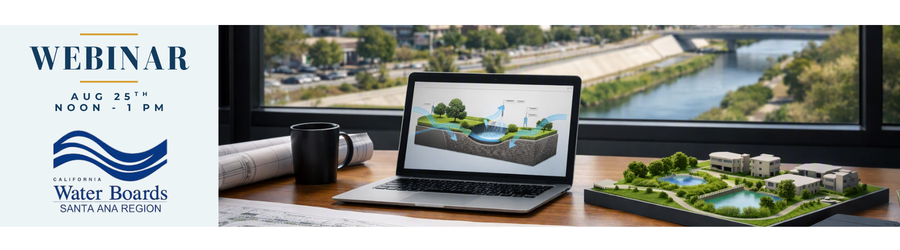
Despite widespread concerns from public works agencies (in Orange, Riverside, and San Bernardino Counties) and the private sector, including housing and construction industries, the Santa Ana Regional Water Quality Control Board is moving forward with approval of a new, regional municipal separate storm sewer system (MS4) permit at its September 2026 board meeting.
Because of the potential impact of the new regional MS4 permit on public works projects and most types of new and redevelopment projects, including all housing, the Building Industry Association of Southern California is hosting and presenting an hour-long webinar on Tuesday, August 25th from noon to 1 PM, moderated and led by CICWQ’s Principal Technical Director, Dr. Mark Grey.
The Webinar features a three-member panel of public works and land development experts representing consulting engineering, city-specific permittee perspectives, and housing-forward planning and project entitlement. The new, proposed regional MS4 permit is notable in that it combines three previously individual permits into one overarching permit for an area that is hundreds of square miles in size, and it requires a complete overhaul and update of each county's existing technical guidance support documents into a single standard document now known as Uniform Technical Guidance. This is a major change and impacts all of construction and land development in this large, urban three-county area.
Also to be covered during the webinar is a notable new economic analysis done on behalf of the three-county public works agencies who are the principal permittees and suggests new compliance costs could exceed $11 billion, which is a tremendous fiscal impact, especially for inland communities in Riverside and San Bernardino counties, which include many disadvantaged community areas.